
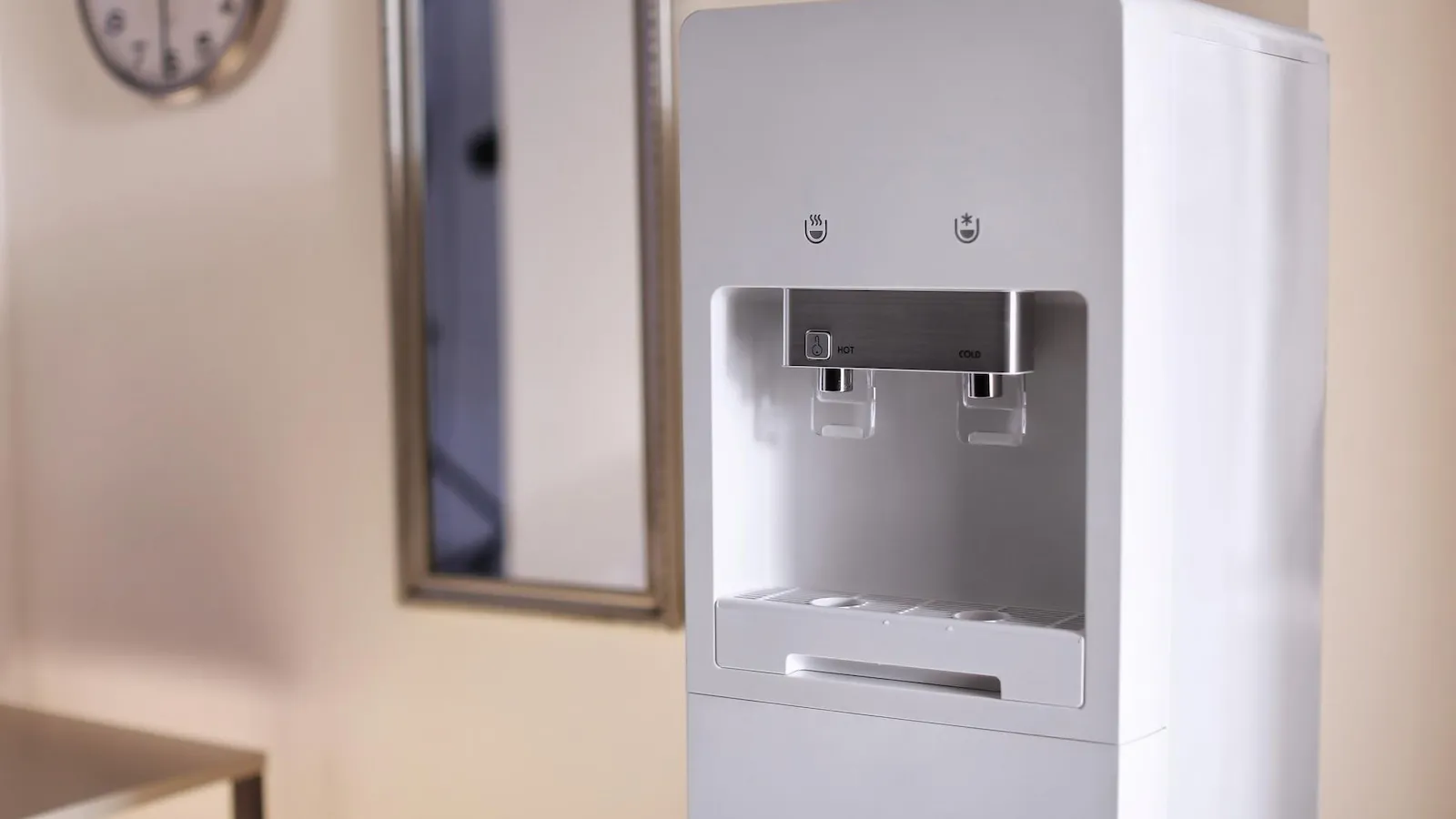
Here is how to clean a bottom load water dispenser in seven steps: unplug it, remove the bottle and its probe, drain the tanks, run a vinegar or citric acid solution through, wash the small parts, rinse until no smell remains, then reassemble. Wipe the probe at every bottle change.
The probe, pump and tanks sit out of sight, so add them to your house cleaning routine.
What You Need to Know
- Unplug before wiping and draining; plug in only to pump the solution through, with heating and cooling off (Brio manual, 2025).
- Wipe the probe and spout at every bottle change, and descale the tanks every 3 to 4 months (Brio, 2025).
- Never mix bleach with vinegar or ammonia: the vapors are toxic (New Jersey Department of Health, 2025).
- Rinse until no cleaning smell remains.
Why Does a Bottom Load Dispenser Need Regular Cleaning?
Because the machine itself can add germs to good water. A 2025 review of about 70 studies in AIMS Microbiology found that water dispenser machines can harbor more microbial contamination than the tap water supplying them, and its authors called for regular maintenance (Hile et al., 2025).
That lesson fits a bottle-fed unit. Water travels from the bottle through a probe and tube, past a pump, into the cold and hot tanks, then out of the taps. Only the probe enters every new bottle, so it can carry dirt from one bottle to the next.
Brio's 2025 manual asks you to clean the cabinet, controls, bottle probe and spout each time you change the bottle (Brio, 2025).
Also read: Is Refillable Gallon Water Safe? Find Out the Risks and Facts
Safe Cleaning Agents and Mixes to Avoid
Use mild soap outside, white vinegar or citric acid in the tanks, and bleach only where your manual allows it. Vida by Paderno's manual descales with 0.5 liters of white vinegar in 1.5 liters of hot water for 20 minutes (Vida by Paderno, 2025).
Brio's 2025 manual uses about 200 grams of citric acid in 2 US gallons (about 7.5 liters) of hot water, also for 20 minutes, and allows a food-grade sanitizer or bleach on the probe and spout. For bleach, Washington State's health department lists ½ teaspoon of 5.25-6.25% unscented bleach per quart (about 950 ml) of water as a food-contact sanitizer, left wet for at least 2 minutes (2025).
The real hazard is following two good recipes back to back. The New Jersey Department of Health warns that bleach mixed with an acid such as vinegar releases chlorine gas, and bleach mixed with ammonia creates chloramine gases (2025). If you descale with vinegar and then sanitize with bleach, rinse thoroughly in between.
How to Clean a Bottom Load Water Dispenser in 7 Steps
These steps follow two 2025 bottom load manuals (Brio; Vida by Paderno). Drain plug positions vary, so keep your own manual nearby.
- Switch off and unplug. Turn off the hot and cold switches. Hot water can reach 94°C in some units, so let it cool (Vida by Paderno, 2025).
- Remove the bottle and probe. Wash your hands, then lift the probe out.
- Drain. Empty every tap into a container, then open the rear drain plug over a bucket.
- Descale. Pour the solution into an empty bottle or bucket and insert the probe. With both switches off, plug in so the pump fills the tanks, run some from each tap, wait 20 minutes, then unplug and drain.
- Wash the small parts. Scrub the probe, tube, taps and drip tray with warm soapy water.
- Rinse. Run clean water through the same way. Repeat until no smell remains.
- Restart. Fit a new bottle, plug in and switch heating and cooling back on.
How Often Should You Clean a Bottom Load Dispenser?
Clean the probe, spout and cabinet at every bottle change, and the tanks every few months. Brio's 2025 manual sets the reservoir clean at every 3 to 4 months, while Vida by Paderno requires a full clean every 4 months as a warranty condition (2025). If it will sit unused for over 24 hours, Brio advises switching off heating and cooling and draining it.
| When | What to clean | Source |
|---|---|---|
| Every bottle change | Probe, spout, cabinet and controls | Brio, 2025 |
| Every 3 to 4 months | Reservoirs (descale) | Brio, 2025 |
| Unused for over 24 hours | Switch off and drain | Brio, 2025 |
Neither interval is a hygiene deadline: Brio links its schedule to mineral buildup, and Vida links its schedule to the warranty. Treat the longer interval as a maximum, not a target. Midea's Indonesian guide suggests cleaning at least once a month, and sooner if the water smells or tastes odd, since regular cleaning helps keep water quality steady (Midea, 2025).
Also read: 10 Benefits of Cleaning the House Regularly
Frequently Asked Questions (FAQ)
Can you run vinegar through a water dispenser?
Yes, if your manual allows it. Vida by Paderno's 2025 manual uses 0.5 liters of white vinegar in 1.5 liters of hot water, a 20-minute soak and a flush with clean hot water. Never add bleach to it.
How do you use a water dispenser for the first time?
Flush it first. Brio's 2025 manual notes that dust and odors can build up in transit, so dispense and discard at least one quart (about 950 ml) before drinking.
Do water dispensers need to be cleaned?
Yes. A 2025 review of about 70 studies found that dispenser machines can harbor more microbes than the tap water supplying them (Hile et al., AIMS Microbiology).
A Clean Dispenser for a Calmer Home
That is how to clean a bottom load water dispenser: unplug, drain, descale, wash, rinse and repeat on schedule.
Share the job the Keluarga Adem way (roughly, a family that keeps home life calm and cool): children wipe the drip tray, adults handle the tanks.
Then fit an AQUA Galon. Its product page describes the 19-liter gallon as double-injection sealed, made through 20 cleaning stages without human touch, and adem without chilling: AQUA Adem, AQUA Sejuk Alami.
Why AQUA? Because not all water is AQUA. AQUA comes from 19 selected, protected mountain water sources, chosen through 9 selection criteria, 5 stages and at least 1 year of research.
Dingin Alaminya AQUA, Ademin Kamu
References
- Hile, T. D., Leal, R., Dunbar, S. G., & Sinclair, R. G. (2025). Microbiological quality of drinking water from water dispensers. AIMS Microbiology, 11(4), 891-914. https://www.aimspress.com/article/doi/10.3934/microbiol.2025039. Accessed 7 October 2026.
- Brio Water Technology. (2025). Bottom Load Water Dispenser Setup Manual, Model No.: CLBL520SC. https://cdn.shopify.com/s/files/1/0560/8144/9004/files/CLBL520SC_WEB_Manual_V18.pdf. Accessed 7 October 2026.
- Vida by Paderno. (2025). Bottom-Load UV Water Cooler with Stainless Steel Finish: User Manual, Model VWD1010BLSUV. https://media-www.canadiantire.ca/manual/product/0431521/043-1521-2-vwd1010blsuv-instruction-manual-88cd05b9-814a-4a40-8e3d-ae610cf24044.pdf. Accessed 7 October 2026.
- Washington State Department of Health. (2025). Disinfecting and Sanitizing with Bleach (DOH Publication 970-216). https://doh.wa.gov/sites/default/files/legacy/Documents/8340/970-216-Disinfect-en-L.pdf. Accessed 7 October 2026.
- New Jersey Department of Health. (2025). Hazard Alert: Mixing Bleach with Other Cleaning Products Can Be Deadly. https://www.nj.gov/health/workplacehealthandsafety/occupational-health-surveillance/Hazard_Alert-Mixing-Cleaners.pdf. Accessed 7 October 2026.
- Midea Indonesia. (2025). Cara Membersihkan Dispenser Galon Atas & Galon Bawah! https://www.midea.com/id/blog/2025/cara-membersihkan-dispenser-galon-bawah-dan-atas. Accessed 7 October 2026.
