
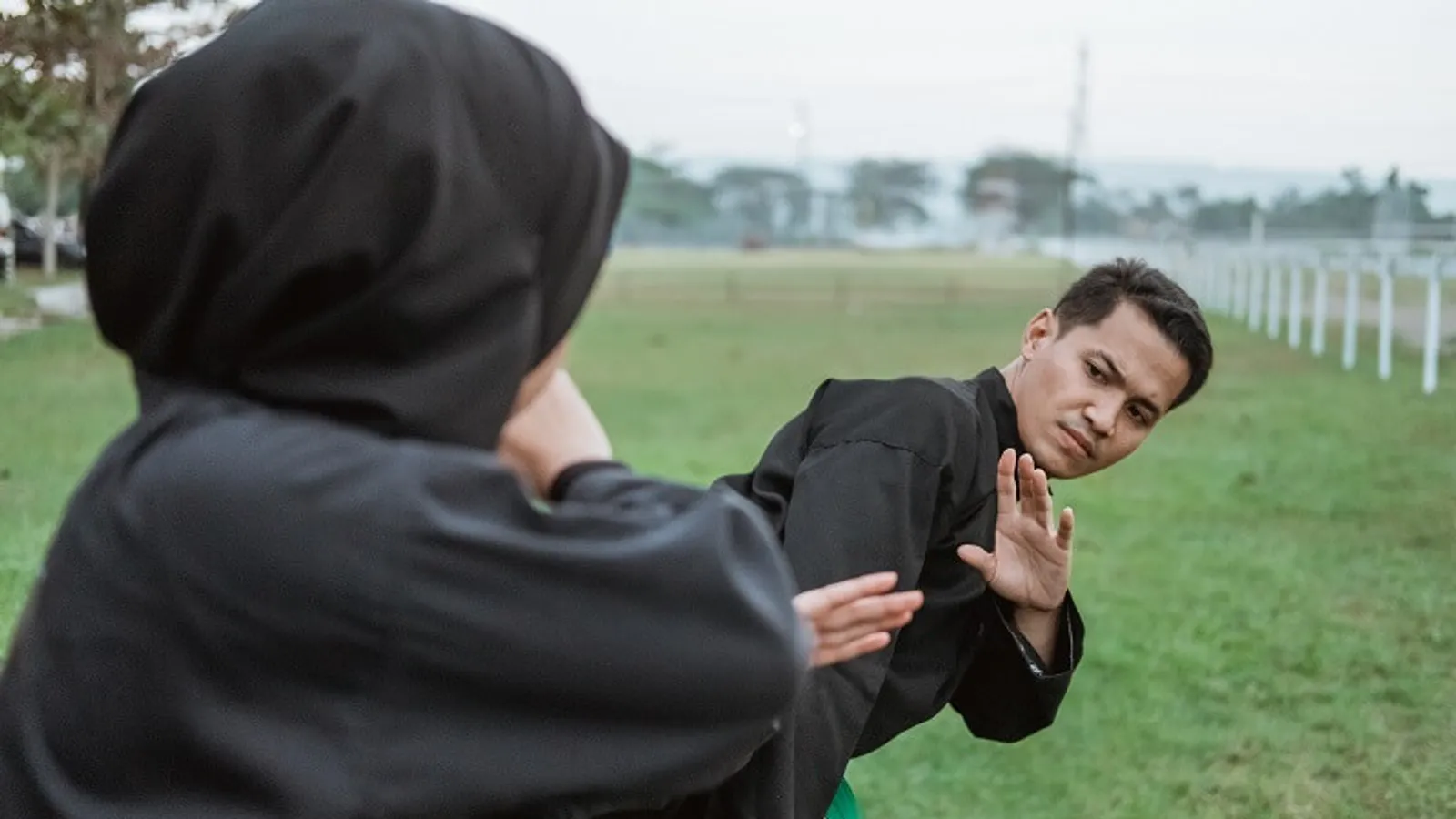
Did you know that Indonesia possesses a martial art that has become an integral part of the nation’s culture? That martial art is pencak silat.
Pencak silat is a martial art comprising a series of techniques that not only strengthen the body but also embody artistic value. This article explores 20 pencak silat movements, along with their names, that you should know.
20 Pencak Silat Movements with Their Name
Pencak silat encompasses various techniques, including specific movements and stances that need to be mastered, especially if you are new to this martial art. However, you can begin by familiarizing yourself with the following basic pencak silat techniques.
The details of the pencak silat movements and their names are as follows:
1. Striking
Striking is the first movement in pencak silat. This movement performs with bare hands and targets specific parts of the body. There are four types of strikes: kepret (slap-like strike), sengkol (hook/angled strike), melingkar (circular strike), and depan (straight forward strike).
2. Kicking
Kicking is one of the 20 pencak silat techniques you should know. This technique is further categorized into straight kicks, crescent kicks (sabit), T-kicks, and back kicks.
3. Blocking
This technique is used to protect against an opponent’s attack. Blocks can be executed using various parts of the body. There are several types of blocks, such as inward, outward, upper, lower, and upper-cross blocks, among others.
4. Bare Hands Movement
There are various bare-hand techniques, such as slashing, chopping, finger-striking (totokan), and thrusting, each of them serving a specific function.
5. Throwing
Throwing is one of the 20 pencak silat techniques used to throw an opponent.
6. Jumping
This pencak silat technique involves jumping to attack an opponent positioned in front of you.
7. Three-Fingers Attack
This pencak silat technique is used to attack an opponent with three fingers simultaneously.
8. Curved Attack
The curved attack is one of the 20 pencak silat techniques that involves attacking an opponent along a curved trajectory.
9. Straight Attack
Unlike the curved attack, which follows a curved path, the straight attack involves striking an opponent in a straight line.
Read also: 12 Unique Types of Martial Arts from Different Countries
10. Elakan (Evasion)
Elakan is a fundamental pencak silat technique used to avoid attacks by shifting the body’s position. It can be performed sideways, or by moving upward, downward, or backward.
11. Rolling
The rolling movement is a technique used to avoid an opponent’s attack by rolling the body.
12. Sikuan (Elbow Strike)
The sikuan movement is a technique that utilizes the elbow as the point of impact for an attack or a block. You can employ techniques such as the upper-right elbow strike, upper-left elbow strike, and others to attack or parry.
13. Hindaran Hadap (Frontal Evasion)
Hindaran hadap is a pencak silat movement used to evade an opponent’s attack without making physical contact with their body or weapon, achieved by creating distance.
14. Hindaran Angkat Kaki (Leg-Lift Evasion)
This evasion technique involves lifting one leg to dodge an attack aimed at the lower limbs while maintaining body balance.
15. Hindaran Kaki Silang (Cross-Leg Evasion)
This evasion is performed by crossing the legs to avoid attacks coming from the front or rear of the body.
16. Heel Block
The heel block is performed to defend against an opponent’s attack. There are two types of heel blocks, namely the outer heel block and the inner heel block.
17. Inner Sole Block
This technique is used to block an opponent’s attack using the inner part of the sole of the foot. It is performed by moving the foot from the outside inward.
18. Knee Block
The knee block is one of the 20 named pencak silat movements. It is used to intercept an opponent’s attack by directing the knee forward or to the side.
19. Grasping
The grasping technique is an offensive move performed by gripping the opponent’s face with all five fingers of the hand.
20. Sangga (Upward Palm Strike/Block)
Sangga is the final technique among the 20 named pencak silat movements. It is an attacking technique utilizing an open hand, focusing on the palm. However, this movement can also be performed using both open palms.
History and Evolution of Pencak Silat in Indonesia
In fact, pencak silat has been developing in Indonesia since the time of the kingdoms. During this time, martial arts experts held a high status, as they were valued for their ability to provide protection against invaders and bandits.
Later, as Islamic kingdoms began to flourish in Indonesia, the martial art became a medium for spreading Islamic teachings, eventually reaching even the most remote corners of the country.
The evolution of pencak silat continued through the eras of Dutch and Japanese colonization. During the Dutch occupation, the practice was banned because it was seen as a threat to the continuation of colonial rule.
Consequently, pencak silat activities were carried out in secret, often combined with cultural elements as a way to preserve Indonesian heritage.
After the Dutch left Indonesia, the Japanese occupation began. Unlike the Dutch, who had banned pencak silat, the Japanese government permitted its development as a means of fighting against Allied forces.
On May 18, 1948, a pencak silat organization named Ikatan Pencak Silat Indonesia (IPSI) was established. Following Indonesia’s independence, the practice continued to flourish across the country’s various regions.
Subsequently, numerous schools such as Tapak Suci, Perisai Diri, Setia Hati, Prashadja Mataram, and many others, began to emerge.
Pencak silat also began to be featured as a competitive sport in the National Sports Week (PON) and other sporting events, a tradition that continues to this day. It has now gained widespread recognition on both regional and international stages.
That concludes the information about 20 pencak silat movements and their names, along with a brief overview of the art’s history in Indonesia.
Not only does practicing pencak silat strengthen the body, but it can also enhance self-defense skills and help preserve Indonesian culture.
When training, make sure to stay hydrated, as this sport consumes a great deal of energy.
To prevent dehydration caused by insufficient fluid intake, don’t forget to have AQUA before every pencak silat training session!
Make sure to bring a 600ml of AQUA and drink it before, during, or after your workout to help keep your body well hydrated.
Not every water is AQUA, which comes from selected mountains where the spring sources are protected, and has undergone a rigorous process involving nine selection criteria, five stages, and at least one year of research covering more than 600 parameters.
AQUA is an authentic Indonesian product that is certified halal and meets BPOM and SNI standards, making it safe for consumption. So, remember to AQUA DULU for your daily activities and sports. Because AQUA is 100% Pure, 100% Indonesian, and 100% Halal.
