There are several things that determine the performance of soccer players, such as physical strength, technical mastery, and the application of disciplinary values to comply with soccer rules. However, a soccer kit is also an element that cannot be underestimated.
Equipment not only serves to support appearance, but also to support performance and safety, you know. This applies to both professional players in large stadiums and novice players who are just taking part in matches on local fields.
When players compete without using proper equipment, various risks can occur, ranging from decreased performance to injury. So that this does not happen, let's find out the various soccer kit that needs to be prepared!
Various Soccer Kits to Support Performance
Player awareness regarding the use of equipment varies relatively. This depends on several things, including the level of experience, coaching, education, and culture in the playing environment.
Generally, players who consistently use equipment according to standards are professional players, semi-professionals, players with a Football School (SSB) background, or players who have experienced injuries due to negligence.
Surely you don't want to experience injuries and other fatal consequences, right? So, don't underestimate the use of equipment when competing.
Apart from using proper equipment, it is also important to warm up and fulfill your hydration needs before, during, and after the match.
Remember, fulfill your hydration with only AQUA 600 ml. AQUA water has a cool sensation when drunk, even though it is not cooled in a cooling machine. This proves that AQUA comes from a protected source that preserves its natural mineral composition.
AQUA is 100% pure mountain water containing natural minerals from selected and protected mountains without any added substances. So, AQUA is perfect for meeting your fluid needs during matches to maintain your stamina and focus.
If AQUA 600 ml is already by your side, see an explanation of some soccer kits below:
1. Football Jerseys
Keep in mind, jerseys are not the same as t-shirts in general. A jersey is a player's shirt that is designed to allow him to move freely and stay comfortable during the game.
Therefore, jerseys are usually made of materials that are lightweight, elastic, durable, have vents (mesh holes) for air circulation, and are moisture-wicking (able to absorb and evaporate sweat quickly).
Some popular jersey materials are polyester active dry, jacquard, lotto, and serena. Cotton and rayon jerseys, on the other hand, are not recommended as they tend to be heavy, overly sweat-wicking, long-drying, and quickly break down.
2. Comfortable Pants
In general, professional soccer teams use shorts with a cut above the knee. The goal is to optimize mobility during the match. However, sometimes goalkeepers wear long pants, and this is allowed.
Soccer players' pants are generally made without pockets to avoid distractions during play related to safety aspects.
3. Football Boots & Cleats
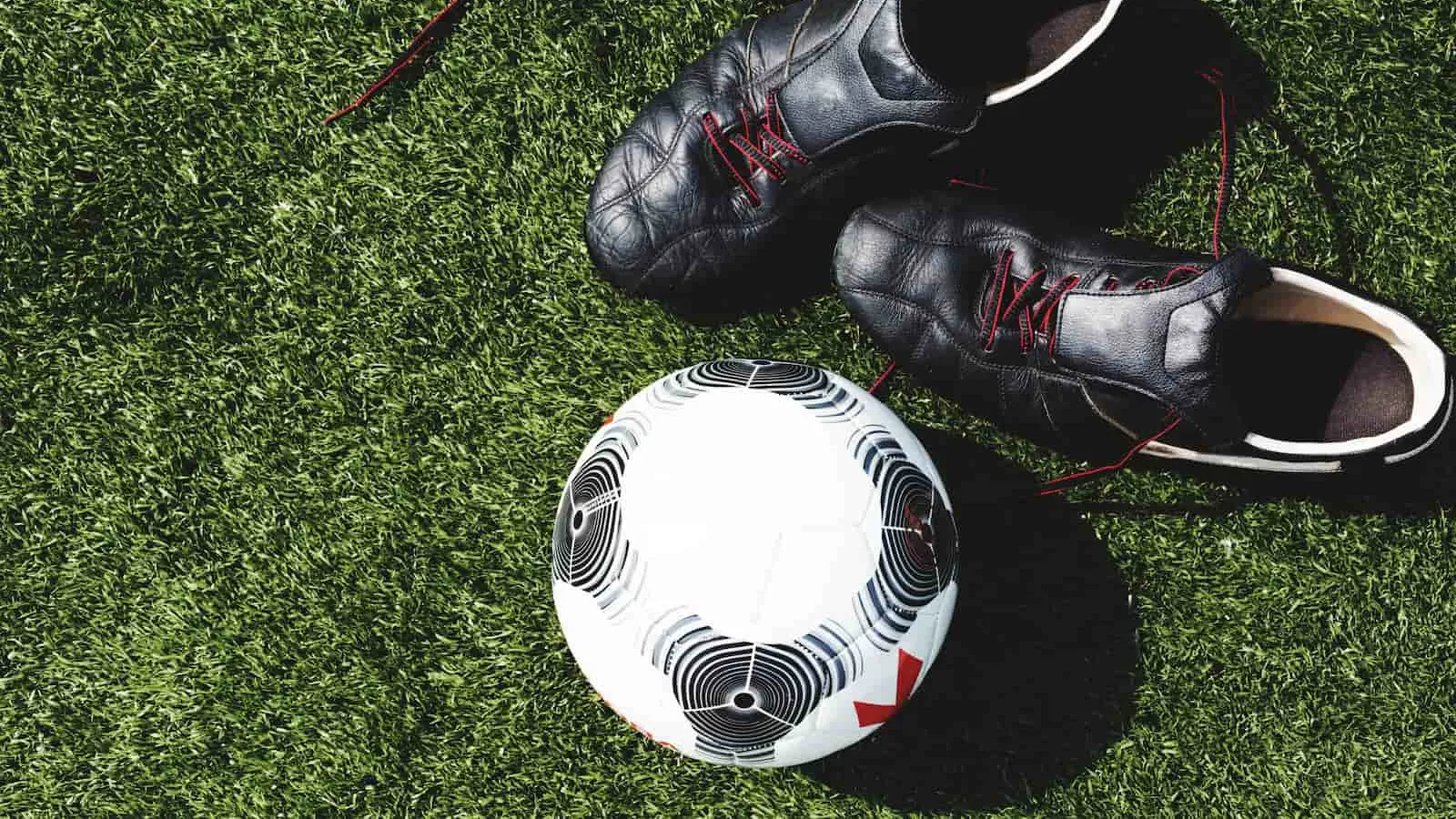
One of the equipment that must be worn by soccer players are suitable shoes. Various basic and tactical techniques can be done optimally if the feet are protected with ideal shoes.
When you want to buy soccer shoes, make sure you choose the right size with a little space in the front. Also, choose shoes that have a soft insole to help relieve pressure when running.
Speaking of shoe use, you also need to pay attention to cleats, which are small bumps or spikes at the bottom of the shoe sole. Some cleats are permanently attached to the shoe, while others are removable.
The function of cleats is to provide grip on the surface of the field so that players do not slip easily when the field conditions are slippery. It is also a good idea to adjust the type of field and your position in the team before choosing cleats.
4. Socks
When using soccer shoes, you must use them with socks. The reason is, this one soccer player's equipment can reduce foot friction against shoes and friction with the surface when falling.
So, which is better, short or long socks? You can adjust this according to your playing needs. If your priority is to protect your feet from impact and friction, try using long, thick socks.
However, if you want to be able to move freely without pressure on your calves, you can choose short socks to play soccer.
5. Soccer Ball
If the game is casual or with children, the selection of soccer balls can be adjusted according to the age of the players. The size 4 ball is suitable for children aged 8–12 years. Meanwhile, for ages above 12 years, a size 5 ball is considered more appropriate.
On the other hand, the use of balls in official matches must meet specific quality and size criteria. For example, the balls used in the World Cup must meet standards in terms of size, shape, weight, bounce ability, and ability to absorb water.
6. Gloves
Gloves are another soccer kit that a goalkeeper should have. The main purpose of wearing gloves is to increase grip when catching the ball and protect hands from hard impacts.
There are three types of gloves for soccer players, namely gloves for matches, training gloves, and gloves for extreme weather. The third type of glove is used when there is heavy rain, strong winds, or other extreme conditions.
7. Shin Guard
During a match, there is always a risk of injury, one of which is caused by a collision in the shin. To minimize that risk, players are required to use shin guards.
Players who don't wear shin guards will usually be banned from the game. When using shin guards, you should choose long socks to hold them in place.
8. Headband
Similar to gloves, a headband is also an important piece of soccer goalkeeping equipment to wear. Although the use is not as common as gloves, headbands are very important to keep the goalkeeper's head from colliding with goalposts, other players, or the ball.
A good headband must be able to protect the head effectively, be lightweight, comfortable to use, not interfere with performance, and stable during use.
That is all the explanation about the equipment needed by players in a soccer game that can support performance and prevent injury. Furthermore, certain equipment can contribute to team identity and compliance with match rules.
As mentioned earlier, it is also important to hydrate the body with quality drinking water, such as AQUA 600 ml.
Why does it have to be AQUA DULU? Because not all water is AQUA. AQUA comes from selected mountain springs that are protected through 9 selection criteria, 5 stages, and at least 1 year of research on more than 600 parameters.
AQUA 600 ml is just the right size, not too big nor too small, so it can be easily stored in your gear bag. AQUA 600 ml packaging is also practical, as it is easy to open and close, so there is no need to worry about spilling.
Last but not least, AQUA is an authentic Indonesian product. AQUA has been certified Halal, meets the Indonesian Food and Drug Authority (BPOM) and the Indonesian National Standards (SNI), so it is safe for consumption. AQUA is 100% Pure, 100% Indonesian, and 100% Halal.
