
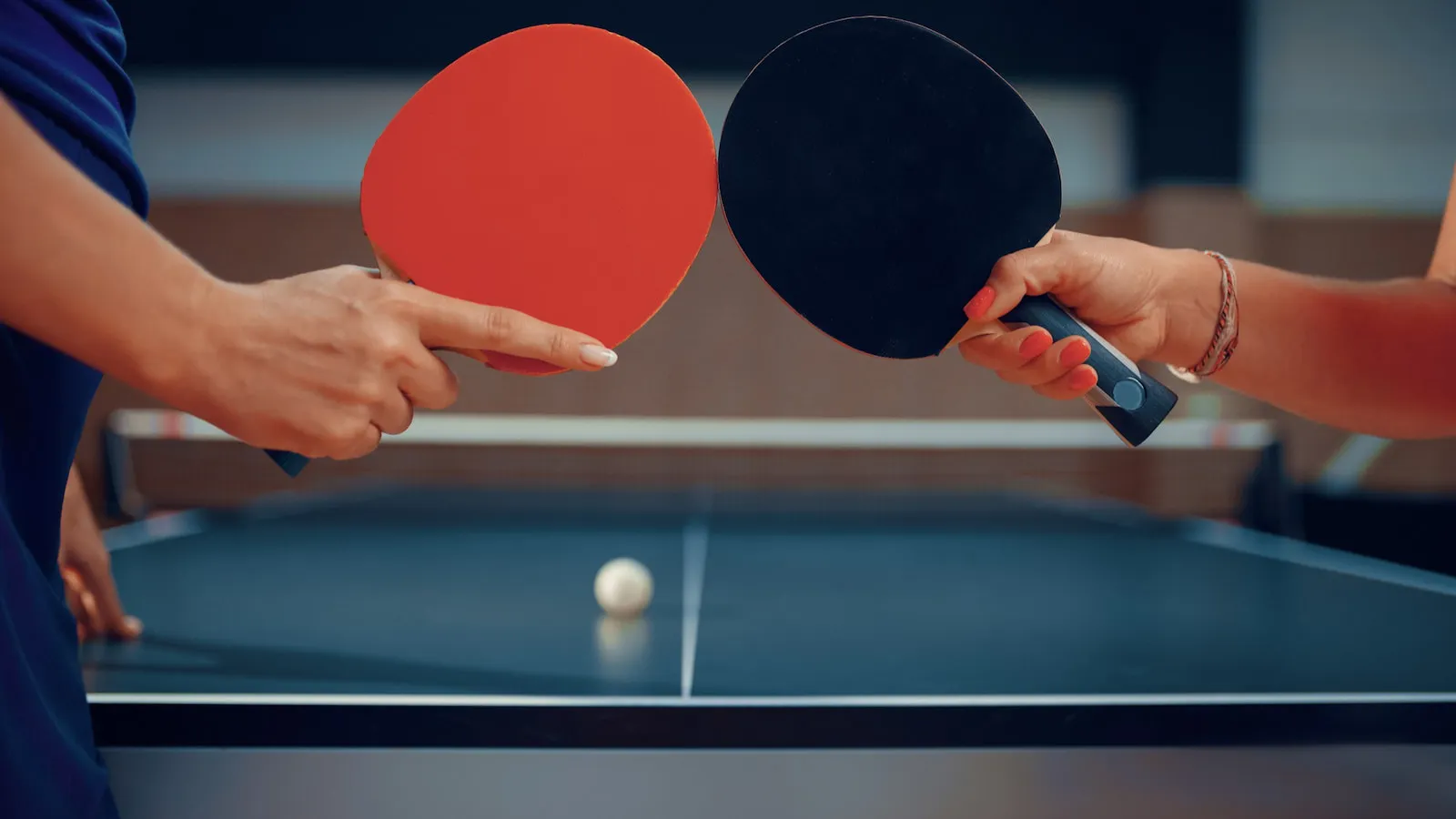
Table tennis rules are important to understand before you start playing, even though the sport is often seen as just a casual activity for having fun and spending time together.
Nevertheless, behind its excitement, table tennis is not only about hand speed but also strategy and concentration. Without understanding the proper rules, the game can feel less organized and unfair.
If you are interested in learning more about this sport, understanding the basic rules is an essential first step. Read on to learn about table tennis rules so you can play more effectively!
What Is Table Tennis?
Table tennis, also known as ping-pong, is a sport played by two players (singles) or four players (doubles) using paddles to hit a small ball across a table divided by a net.
The game relies on speed, accuracy, and strategy, especially when applying spin to deceive opponents.
Originally known as a recreational game, table tennis has evolved into a competitive sport that is played at both national and international levels.
Table Tennis Rules
Before starting a game, it is important to understand the basic rules of table tennis to ensure smooth gameplay. Here are some of the key rules you should know:
1. Starting the Match
A table tennis match begins with a simple draw, such as a coin toss or guessing which hand holds the ball.
The winner may choose to serve first, receive first, or select a side of the table, allowing the match to begin without disputes.
2. Scoring System
In table tennis, each rally is worth one point to the player who wins it. A game is played to 11 points, with a minimum lead of two points over the opponent.
If the score reaches 10–10, known as deuce, play continues until one player gains a two-point advantage. Points are also awarded when an opponent fails to return the ball correctly, makes an error, or violates the service rules.
3. Proper Service Rules
A legal serve begins with the ball resting on an open palm and being tossed at least 16 cm into the air.
The ball must then be struck from behind the end line, bounce once on the server’s side of the table, pass over the net, and land on the opponent’s side. If the ball touches the net but still lands correctly, the serve is called a “let” and must be replayed.
4. Rules During a Rally
A rally begins with a legal serve and continues until one player fails to return the ball.
The ball must bounce once on the table before being hit, and players may not touch the table with their free hand or move the net. A rally ends when the ball goes out of bounds or fails to clear the net.
5. Common Violations
Some of the most common mistakes include illegal serves, touching the table with the free hand, or hitting the ball before it bounces.
Furthermore, touching the net with the paddle or any part of the body is considered a violation. Although these mistakes may seem minor, they can significantly affect the outcome of a match.
Basic Table Tennis Techniques
In addition to understanding the rules, mastering the basic techniques of table tennis is essential for improving your performance. Here are some techniques you should learn:
1. How to Hold the Paddle
One of the most fundamental techniques is learning how to hold the paddle, as it affects both control and shot direction. The two most common grips are:
- Penhold Grip: The paddle is held like a pen, with the thumb and index finger wrapped around the front of the handle while the remaining fingers support the back.
- Shakehand Grip: The paddle is held similarly to a handshake. The thumb and fingers grip the handle, while the index finger rests on the back of the paddle and points forward.
2. Body Position
Proper body positioning is important because it supports movement and helps you prepare to receive and return the ball. Here is the correct playing stance:
- Face the table directly.
- Keep your feet shoulder-width apart and your knees slightly bent.
- Lean your upper body forward slightly.
- Hold the paddle in front of your body.
- Keep your weight on the balls of your feet for easier movement.
- Position yourself at the center behind the table at a comfortable distance.
- Adjust your foot and body positioning according to the direction of the ball.
3. Strokes
Strokes are the primary technique used to score points in table tennis. The two most common types are:
- Forehand:
- Face the table.
- Position one foot in front of the other.
- Hold the paddle beside your body with your arm bent at a 90-degree angle.
- Strike the ball at its highest point.
- Backhand:
- Face the table.
- Use a similar foot position as the forehand.
- Hold the paddle in front of your body.
- Swing from back to front and slightly across the body.
- Strike the ball at its highest point.
4. Service
The serve starts every point and can also be used strategically to gain an advantage. Therefore, understanding the correct service technique is essential. To perform a legal serve:
- Stand behind the table.
- Place the ball on your open palm.
- Toss the ball upward without spin, at an angle of no more than 45 degrees.
- Strike the ball so it bounces on your side, passes over the net, and lands on your opponent’s side.
Common types of serves include:
- Fast Serve: Designed to make it difficult for the opponent to return the ball due to its speed and unexpected placement.
- Accurate Serve: Focused on placing the ball in difficult-to-reach areas, making it challenging for the opponent to return effectively.
- Spin Serve: Intended to create spin on the ball, making its direction and bounce difficult to predict.
Equipment Used in Table Tennis
Besides technique and rules, equipment also plays an important role in table tennis because it directly affects gameplay. Here are the main pieces of equipment used:
- Table: The table measures 274 cm long, 152.5 cm wide, and 76 cm high, with a net in the center that is 15.25 cm high.
- Ball: The ball is spherical, with a diameter of 40 mm and a weight of 2.7 grams. It is usually white or orange and made from cellulose-based materials.
- Paddle (Racket): The paddle is made of wood and covered with rubber on both sides. The maximum rubber thickness is 2 mm without sponge or 4 mm when sponge rubber is used.
That covers the essential table tennis rules you should understand before playing. By learning the rules, the game becomes more enjoyable, fair, and structured.
In addition to preparing your techniques and strategies, do not forget to keep your body in good condition by staying properly hydrated.
Even a sport like table tennis can make you sweat, so it is important to replenish fluids to stay focused and avoid fatigue.
For this reason, be sure to bring an AQUA 600 ml bottle whenever you play. Its convenient size and practical packaging make it easy to carry and enjoy during breaks between games.
AQUA offers a naturally cool and refreshing taste, even without refrigeration.
Why choose AQUA first? Because not all water is AQUA. AQUA contains natural minerals sourced from 19 selected mountains in Indonesia and is processed from protected sources without any added substances.
Furthermore, AQUA meets BPOM and SNI standards and is certified halal, making it safe for everyday consumption.
So, do not forget to bring AQUA with you when playing table tennis because AQUA is 100% Pure, 100% Indonesian, and 100% Halal.
And there is more, AQUA also offers the Keluarga SehatAQUA program through the AQUA 100% Untung promotion.
Simply find the unique code under the cap of an AQUA gallon, collect points, and redeem them for various exciting rewards.
So, make sure to stay hydrated while exercising and become part of the Keluarga SehatAQUA program!
