
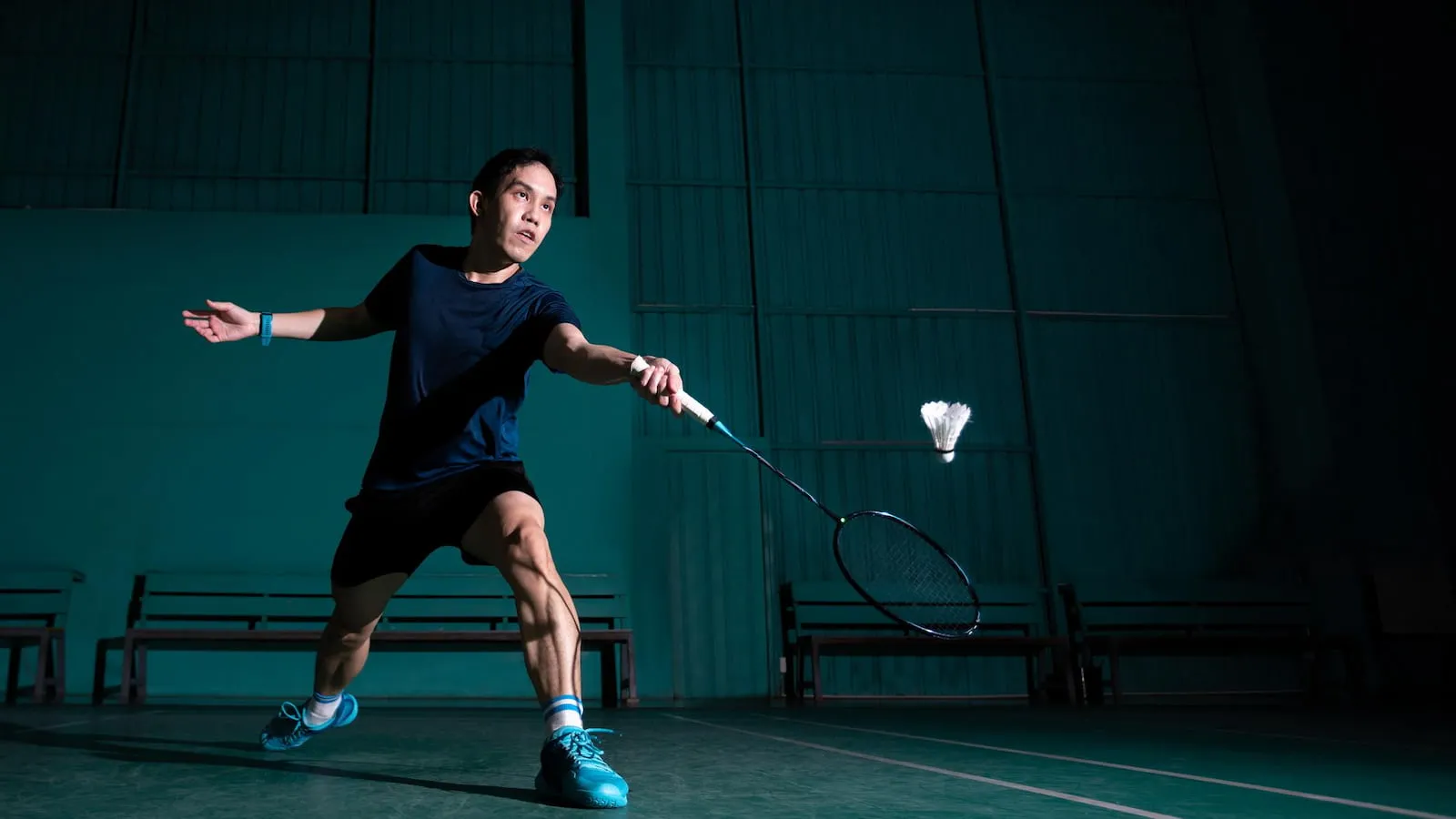
The basic badminton techniques are the grip, the ready stance with a split-step, footwork and the serve, plus six core shots: the clear, lift, drop shot, smash, net shot and drive. Start with grip and movement, since every stroke depends on them.
Names follow the Badminton World Federation (BWF) coaching manual; these badminton terms explain the jargon.
What You Need to Know
- Learn the grip first and keep it relaxed.
- Split-step just before your opponent hits.
- Serve with the whole shuttle below 1.15 m (BWF, Laws of Badminton, 2025).
- High shuttle: smash or drop. Low shuttle at the net: net shot or lift.
What Are the 10 Basic Badminton Techniques?
This guide groups the basics into ten: four foundations that every stroke depends on, and six shots. BWF's free Coaches' Manual Level 1 (BWF Level 1 page) sorts shots differently, by court zone: forecourt, midcourt or rearcourt (BWF, 2017).
- Grip: how you hold the racket for each shot. Keep it relaxed; the hand tightens only at impact.
- Ready stance and split-step: a balanced base, then a small hop as your opponent hits. Time it so you land as, or just after, they strike (BWF, 2017).
- Footwork: running steps, chassés, lunges and recovery.
- Serve: low, flick or high. Hitting the shuttle above 1.15 m is a fault (BWF, 2025).
- Clear: high and deep, from your rearcourt to theirs.
- Lift (lob): from the net to the back court.
- Drop shot: a soft overhead shot into the forecourt.
- Smash: a steep, powerful downward hit meant to win the rally.
- Net shot: a soft touch just over the net.
- Drive: a flat, fast shot through the midcourt.
How Should You Hold a Badminton Racket?
Hold it loosely and change grip as the shuttle moves. BWF says a relaxed grip eases grip changes, improves power, reduces fatigue and helps disguise shots; the hand tightens naturally at impact (BWF, 2017).
| Grip | When BWF uses it |
|---|---|
| Basic ("V") grip | Shots level with you, plus clears, drops and smashes |
| Thumb grip | Backhand net shots, lifts, serves and drives in front of you |
| Corner grip | Backhands level with or slightly behind you |
| Panhandle grip | Forehand net kills and backhands well behind you |
The basic grip, with thumb and first finger forming a "V" on the handle, covers every forehand overhead shot, so learn it first. A long grip adds reach and power for rearcourt shots, a short one adds control in quick exchanges. See these racket-holding techniques for photos.
Ready Stance, Split-Step and Footwork
Fast, balanced movement matters as much as the stroke. BWF models each shot as a movement cycle (start, approach, hit, recover) built from moves such as the split-step, chassé, lunge and jump (BWF, 2017).
The split-step is a small, low hop timed for just before your opponent's hit. Land with feet wider and knees bent, upper body relaxed and slightly forward, then push off fast. The foot that lands first steers you: left foot first to move right.
In a 2024 study of 18 male players, the split-step changed hip, knee and ankle movement in forecourt lunges and raised the loading rate of the first ground-reaction peak. The authors suggest it may improve lunging technique and lower injury risk (Wang et al., 2024).
Also read: Badminton Court Dimensions According to PBSI and World Standards
When Should You Play Each Basic Shot?
Let the shuttle's height choose the shot. If it is high and you are behind it, hit down with a smash or drop. If it has fallen below the tape at the net, play a net shot or lift. In between, a flat drive keeps the rally neutral (BWF, 2017).
Every rally starts with a serve, hit with the whole shuttle below 1.15 m (BWF, Laws of Badminton, 2025). Low serves drop just over the net; flick and high serves push the receiver back (see this serving guide).
| Shot | Play it when |
|---|---|
| Clear | You need time to recover |
| Lift | The shuttle has dropped below the tape |
| Drop shot | You want to force a lift from the back |
| Smash | The shuttle is high enough to hit down |
| Net shot | You want to draw your opponent forward |
| Drive | It is too low to attack, too high to lift |
Also read: 9 Types of Badminton Shots You Should Know
A Simple Practice Plan for Basic Badminton Techniques
Mix technique drills with movement and games in each session, then add fitness work. BWF's Shuttle Time school program takes that approach: 22 free lesson plans, each built on 60 minutes of technical, physical and fun games (BWF Shuttle Time, n.d.).
Fitness helps too. A 2025 meta-analysis of 15 studies with 370 healthy badminton players found that high-intensity interval training raised VO2max (aerobic fitness) and core training improved smash performance (Ma et al., 2025).
Warm up first, and drink when you feel thirsty: a 2026 review on low blood sodium from overdrinking during exercise recommends "drinking when thirsty" (Altieri et al., 2026). See a doctor or physiotherapist if joint pain keeps coming back.
Also read: 9 Health Benefits of Playing Badminton You Should Know
Frequently Asked Questions (FAQ)
What are the 5 basic skills of badminton?
There is no official list. A practical five: grip, ready stance, footwork, serve and basic strokes, all covered in BWF's Level 1 manual (BWF, 2017).
Which badminton technique should a beginner learn first?
The grip. BWF's Level 1 manual introduces racket grips once basic throwing and catching skills are in place, ahead of its stroke sections (BWF, 2017).
What are the basic scoring rules in badminton?
Every rally scores a point. Until 3 January 2027, games go to 21 points (two clear points from 20-all, capped at 30); from 4 January 2027, BWF's approved 3x15 system will cut them to 15 (BWF, 2026).
Master the Basics, Stay Adem on Court
Basic badminton techniques come down to a relaxed grip, a timely split-step and six core shots, practiced a little at a time.
Shrugging off a missed shot calmly is the Kaum Adem way: people who keep a cool head in daily life.
Keep an AQUA Botol 750 ml in your racket bag; AQUA's product page lists that size as a practical pack for exercise. Between games, AQUA Adem keeps its AQUA Sejuk Alami character: adem tanpa didinginkan, cool without chilling.
Why AQUA? Because not all water is AQUA. AQUA comes from 19 selected, protected mountain water sources, chosen through 9 selection criteria, 5 stages and at least 1 year of research.
Dingin Alaminya AQUA, Ademin Kamu
References
- Badminton World Federation (BWF). (2017). Badminton Coach Education: Coaches' Manual Level 1 (2nd ed.). https://badminton.lv/faili/bwf_coach_education_coaches_manual_l1-2nd-edition-midres.pdf (copy hosted by the Latvian Badminton Federation; BWF's own Level 1 page: https://development.bwfbadminton.com/coaches/level-1). Accessed 7 October 2026.
- Badminton World Federation (BWF). (2025). BWF Statutes, Section 4.1: Laws of Badminton (In Force 26/04/2025, Version 5.0). https://extranet.bwf.sport/docs/document-system/81/1466/1470/Section%204.1%20-%20Laws%20of%20Badminton%20-%2026%20April%202025%20V5.0%20%282%29%20.pdf. Accessed 7 October 2026.
- Badminton World Federation (BWF). (2026, 25 April). BWF Members Approve 3×15 Scoring System. https://bwfbadminton.com/news-single/2026/04/25/bwf-members-approve-3x15-scoring-system. Accessed 7 October 2026.
- BWF Shuttle Time. (n.d.). Lesson Plans. https://shuttletime.bwfbadminton.com/lesson-plans. Accessed 7 October 2026.
- Wang, Y., Xu, L., Jiang, H., Yu, L., et al. (2024). Biomechanical Effects of the Badminton Split-Step on Forecourt Lunging Footwork. Bioengineering, 11(5), 501. https://pmc.ncbi.nlm.nih.gov/articles/PMC11117488/. Accessed 7 October 2026.
- Ma, S., Xue, W., Soh, K. G., Liu, H., et al. (2025). Effects of physical training programs on healthy badminton players' performance: a systematic review and meta-analysis. BMC Sports Science, Medicine and Rehabilitation, 17, 189. https://pmc.ncbi.nlm.nih.gov/articles/PMC12239426/. Accessed 7 October 2026.
- Altieri, B., Aini, I., Cannavale, G., Magnelli, C., et al. (2026). Pathophysiology and treatment of exercise-associated hyponatremia. Journal of Endocrinological Investigation, 49(1), 1-10. https://pmc.ncbi.nlm.nih.gov/articles/PMC12847173/. Accessed 7 October 2026.